Updated: September 8, 2026
Some links are affiliate links. I may earn a commission if you buy, at no extra cost to you. I also use AI tools to research and draft; I review before publishing.
Who this is for / not for
For: Pellet-stove homeowners who already own a shop vac (or are about to buy “just one more vac”) and want a clear answer: will it handle fine pellet ash, or do you need a dedicated ash vacuum?
Not for: People shopping fireplace-only listicles, or anyone hoping for invented “X house fires from shop vacs” scare stats.
If you already know you need an ash vac and are picking a model, start with our Best Ash Vacuum for Pellet Stoves (2026) pillar — or the head-to-head PowerSmith PAVC101 vs Pellethead Ash Vault Pro (2026).
Job to be done
Clear ultra-fine pellet ash from the burn pot, ash pan, and clean-outs without fogging the living room, clogging a shop-vac filter in one session, or putting warm ash into a tool that wasn’t built for it.
This page is based on specs, manufacturer guidance, stove-manual themes, and published explainers as of Sep 8, 2026. We did not hands-on test vacuums for this article.
Side-by-side: ash vac vs shop vac
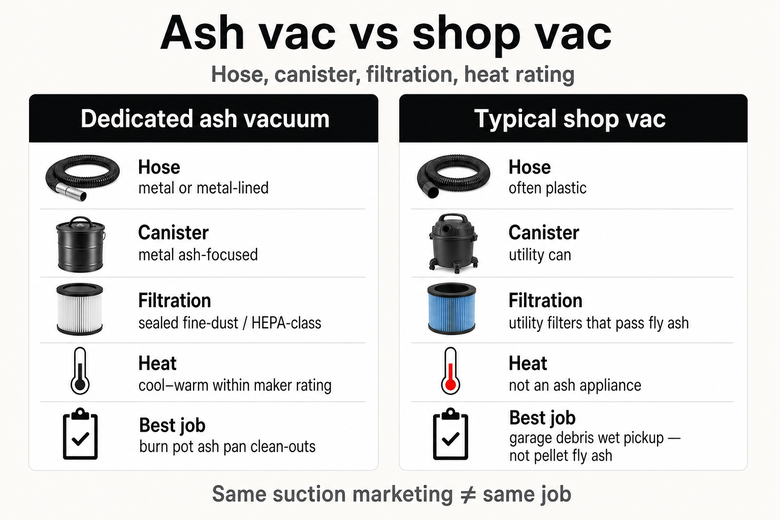
| Dedicated ash vacuum | Typical shop vac | |
|---|---|---|
| Hose | Metal or metal-lined | Often plastic |
| Canister | Metal, ash-focused | Plastic or metal utility can |
| Filtration | Sealed fine-dust / HEPA-class or dual fire-resistant stack | Utility filters / bags that often pass fly ash |
| Heat | Designed for cool–warm ash within maker rating (many cite up to 140°F) | Not an ash appliance |
| Wet pickup | Usually dry/ash only (check model) | Often wet/dry |
| Best job | Burn pot, ash pan, pellet clean-outs | Garage debris, water, construction dust — not pellet fly ash |
Same suction marketing language does not mean the same job. Pellet ash is finer than most wood ash; it escapes mediocre filtration and hangs in the air.
Why pellet ash beats shop-vac filters
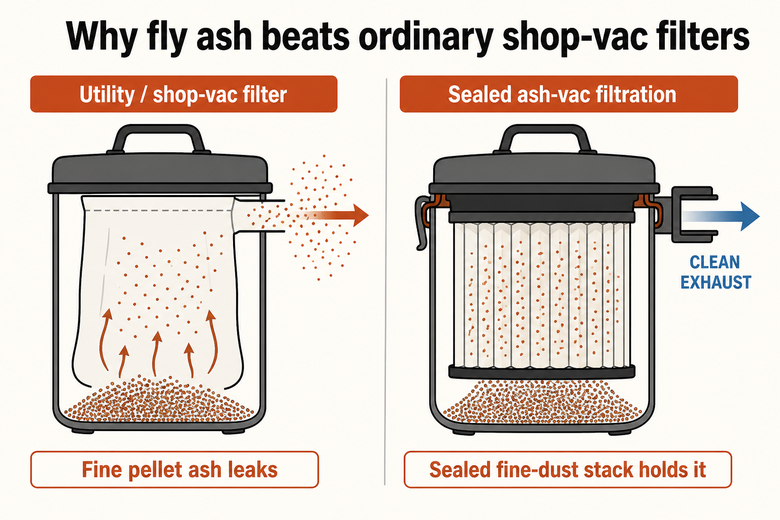
- Particle size. Fly ash from pellets behaves like talc — it loads paper/cloth filters fast and can exit the exhaust if the seal isn’t built for it.
- Hose materials. Plastic shop-vac hoses are the wrong default near warm ash. Ash vacs use metal or metal-lined hose for a reason.
- What manuals say. Stove makers repeatedly tell owners to use an approved ash vacuum and a cold stove — not a household or generic shop vac as the primary ash tool (e.g. RIKA-style “certified ash vacuum” language; Magnum-style cold + approved ash vac notes).
We are not claiming a shop vac will always catch fire. We are saying manufacturers designed ash vacs for this chore, and stove docs point that way.
When a shop vac is still fine
Keep the shop vac for:
- Garage / driveway debris
- Wet pickup (if it’s a wet/dry model)
- Sawdust and non-ash jobs
Do not use it as your plan for weekly pellet ash if you care about indoor air and filter life. “I’ll just be careful once” is how people fog a room.
Buy an ash vac if / keep the shop vac if
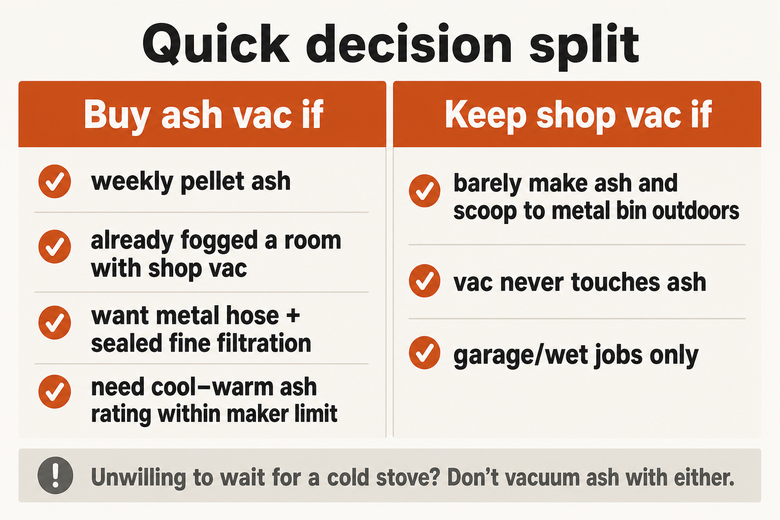
Buy a dedicated ash vac if
- You clean pellet ash weekly (or more) in heating season
- You’ve already watched fine ash puff out of a shop vac
- You want metal hose + sealed fine filtration as defaults
- You want a tool rated for cool–warm ash within the maker’s limit (not live coals)
Soft picks from our pillar (tagged Amazon):
- PowerSmith PAVC101 — value / long cord (~$79 street, Sep 8, 2026)
- Pellethead Ash Vault Pro (corded) — hose reach / 5 gal / 5-yr warranty ($115 brand / $139 Amazon)
Full compare: PAVC101 vs Ash Vault Pro.
Keep using only a shop vac if
- You barely make ash and hand-scoop into a lidded metal bin outdoors
- The vac never touches ash — only garage work
- You’re unwilling to wait for a completely cold stove (then you shouldn’t vacuum ash with anything)
Safe use (either tool — but prefer ash vac)
- Shut the stove down; unplug if your manual requires it for service.
- Wait until stove and ash are completely cold per the manufacturer.
- Stir with a metal tool; if warm, wait longer.
- Vacuum burn-pot holes, ash pan, then only clean-outs your manual allows.
- Empty outdoors into a lidded metal container away from combustibles.
No universal “wait X hours” rule here — manuals disagree with blog round numbers. Follow your stove first. Warm-ash ratings (e.g. up to 140°F on many ash vacs) are not permission to vacuum glowing embers.
Objections
“My shop vac has a HEPA filter.”
Better than nothing for dust; still usually the wrong hose, seal, and heat story for pellet ash. Ash vacs exist as a category for a reason.
“I’ll buy a fine filter bag and be done.”
Possible for rare, fully cold ash outdoors. Weak plan for weekly indoor pellet maintenance.
“Ash vacs are just rebadged shop vacs.”
Form factors overlap. Differentiate on metal hose, sealed fine filtration, and maker ash ratings — then buy on those criteria (pillar).
“Prove shop vacs cause fires.”
We won’t invent incident stats. Stove and ash-vac makers warn for a reason; treat that as the bar.
Related guides
Sources
- PowerSmith PAVC101 product specs (metal hose/canister, warm ash up to 140°F) — powersmithproducts.com
- Pellethead Ash Vault Pro specs (metal-lined hose, dual filtration, resistant ≠ proof) — pellethead.com
- RIKA Integra consumer cleaning guide themes — certified ash vacuum; cool stove before service
- Magnum Winchester owner/service language — cold stove + approved ash vacuum for ash cleanup
- Generic shop-vac vs ash-vac explainers (thin; we stay pellet-specific)
- Live pillar — Best Ash Vacuum for Pellet Stoves (2026)
- Price snapshots Sep 8, 2026 — Amazon/Walmart PowerSmith ~$79; Pellethead $115 / $139 corded
Leave a Reply